
Here’s a bond with a 5% coupon that yields 5.96%.
This Chicago municipal bond trades at $89.75, a discount to par.
You collect the 5% coupon, and you also get back $100 at maturity on a bond you paid less than $90 for.
Put the two together and the yield to worst comes out at 5.96%.
Why the after-tax view changes the picture
Most yield comparisons ignore taxes, and that’s where munis get interesting.
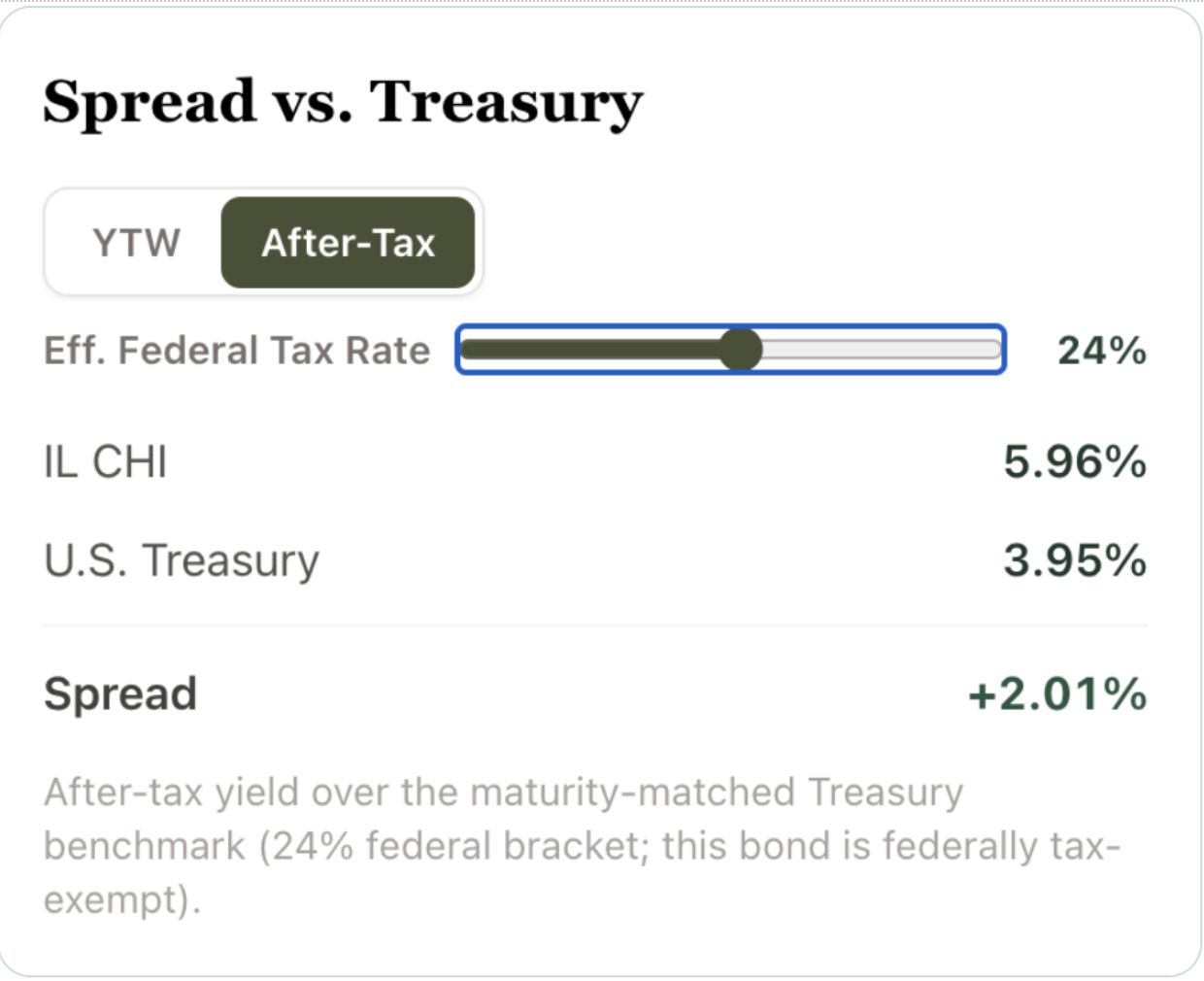
At a 24% federal bracket, a maturity-matched Treasury yielding about 5.20% before tax works out to 3.95% after federal tax.
The muni’s 5.96% is federally tax-exempt, so the comparison is 5.96% against 3.95%.
That’s a 2.01 percentage point advantage.
Flip it around and the muni’s tax-equivalent yield at 24% is roughly 7.84%.
That’s the number a taxable bond would have to pay to match it.
Why it isn’t a free lunch
The extra yield is compensation for something.
Chicago isn’t a AAA credit, and a bigger spread than a Treasury usually means more risk, whether that’s credit risk, liquidity or both.
Treasuries are exempt from state and local income tax, which this comparison doesn’t capture.
Yield to worst also assumes the bond could be called early, and your actual return depends on what the bond does.
The price discount matters for taxes too.
Munis bought at a market discount can generate taxable income at maturity, so “tax-exempt” may not cover every dollar of the return.
The playbook for fixed income investors
In a 24% bracket or higher, always compare muni yields on an after-tax basis, not just headline yield.
Compare against a maturity-matched Treasury, not just any Treasury.
Credit quality and call features matter as much as the yield number.
Your own bracket and state tax situation can move the answer in either direction.
Bottom line
2.01 point after-tax advantage is large. But the muni yields more because you’re taking on more risk, and the right answer depends on your tax bracket, your state, and how comfortable you are with the issuer.