
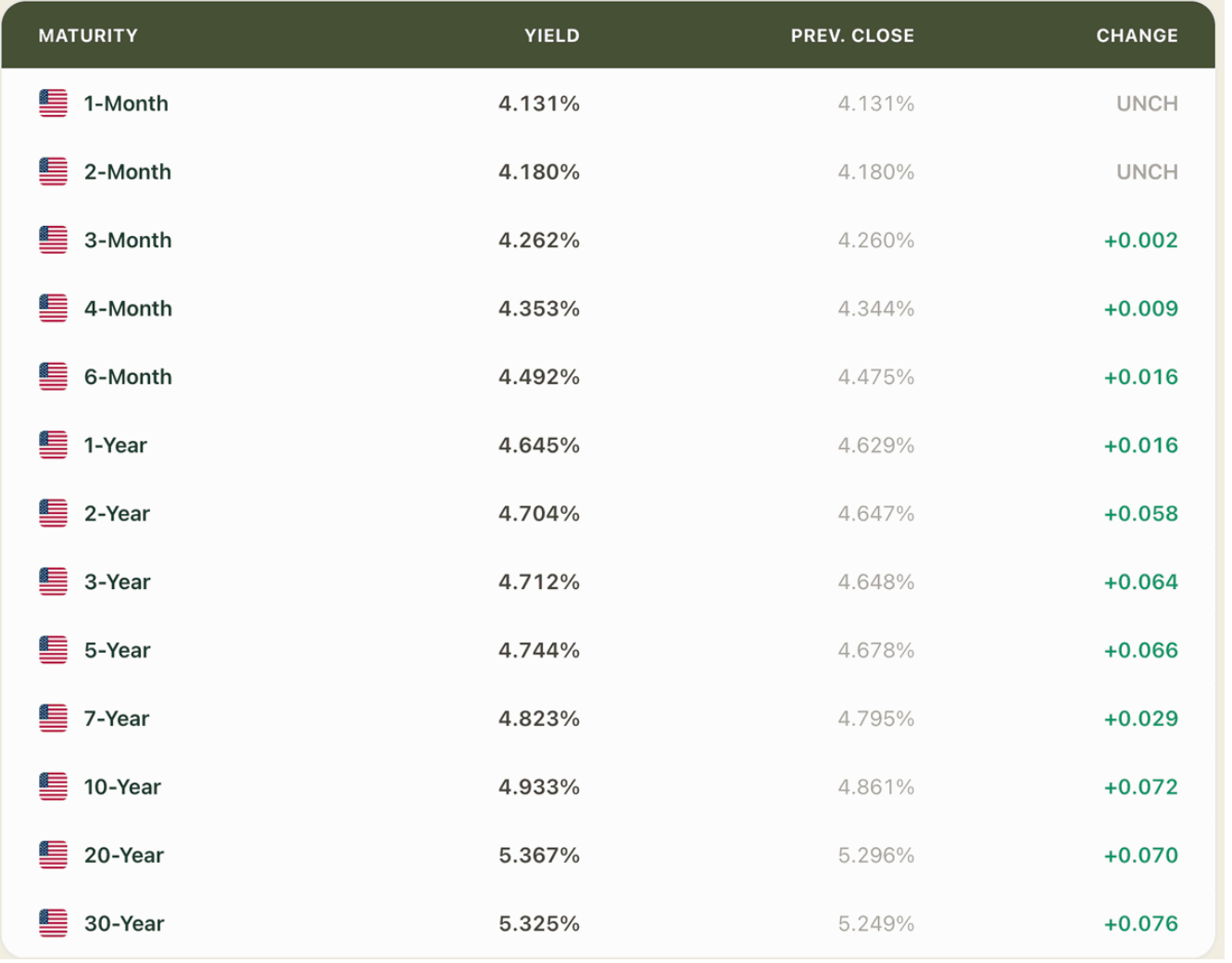
The retreat was led by longer maturities, and it pushed the 3-year and longer yields higher for the abbreviated week.
The 2-year note continued to underperform.
More than half of the losses came at the cash open, after an overnight slide along with improved sentiment in global tech stocks, and news that Pablo Hernandez de Cos was chosen to lead the European Central Bank.
A shallow bounce early on gave way to steady selling into the late morning, and the range narrowed at the lows ahead of the early close.
What moved markets
ECB leadership: Pablo Hernandez de Cos was chosen to succeed Christine Lagarde as head of the European Central Bank, in line with speculation.
France: France dipped into a technical recession after final Q3 GDP showed a deeper contraction of 0.2%, versus 0.1% expected.
Equities and oil: Stocks built on their starting gains, and oil reversed from a ten-day high reached overnight, giving up about $1 per barrel for the week.
Dollar: The Dollar Index rose 0.4% to 104.05, up 0.2% for a week that started with a fresh 20-month high.
South Korea: Officials plan an emergency meeting Monday with the chairs of the country's five largest financial groups to assess how much more they could contribute.
China: Xinhua reported that Central Huijin, a lead player in the "national team" of state investors, would enhance its role as a quasi-stabilization fund. October industrial profit rose 16.0% year to date, versus 15.5% before.
Japan: Bank of Japan board member Tamura argued for faster rate hikes if inflation overshoots. November Tokyo core CPI rose 2.9% year over year (expected 3.0%; last 2.6%).
Eurozone Data
Eurozone consumer confidence was -16.9 (as expected; prior -17.9), and the business and consumer survey came in at 95.8, below the 97.2 expected.
France's November CPI rose 2.9% year over year (expected 3.2%; prior 3.4%), and Spain's rose 4.1% (expected 4.7%; prior 4.9%), so inflation came in below forecasts in both.
Germany's unemployment rate was 6.4%, as expected.
U.S. Data
The advance goods trade deficit widened to $149.5 billion in October, against a $131.0 billion consensus and a revised $135.1 billion in September.
Advance retail inventories rose 0.8% (after a revised 0.7%), and advance wholesale inventories rose 0.9% against a 0.4% consensus.
Commodities and Currencies
WTI crude: down 1.0% to $82.85 per barrel
Gold: up 3.7% to $3,668.10 per ounce
Copper: up 3.3% to $5.60 per pound
EUR/USD: down 0.3% to 1.0932
GBP/USD: down 0.1% to 1.3093
USD/CNH: unchanged at 6.6549
USD/JPY: up 0.2% to 159.55
The Week Ahead
The jobs report is the highlight. On Friday, November nonfarm payrolls are expected at 88,000 (prior 165,000), with the unemployment rate expected to stay at 4.1% and average hourly earnings expected up 0.3% (prior 0.4%).
Earlier in the week:
Monday: November Chicago PMI (consensus 55.7; prior 55.3)
Tuesday: Final S&P Global manufacturing PMI, October job openings (consensus 7.450 million; prior 7.523 million), construction spending and November ISM manufacturing (consensus 55.0; prior 55.5)
Wednesday: November ADP employment change (consensus 75,000; prior 86,000)
Thursday: Weekly jobless claims (consensus 193,000; prior 189,000), October factory orders and November ISM non-manufacturing (consensus 54.5)
What this could mean for fixed income investors
Yields ended the week higher, with the 2-year rising the most. Short-term yields are rising faster than long-term ones.
A 4.93% 10-year and a 5.32% 30-year give investors more income than a week ago, but they also reflect more price pressure.
Heavy data next week, especially the jobs report on Friday, could move yields in either direction.
A stronger dollar and global central bank news, from the ECB's new leader to the Bank of Japan, can influence U.S. yields.
If you're adding bonds, consider spreading purchases over time rather than trying to pick a top.