
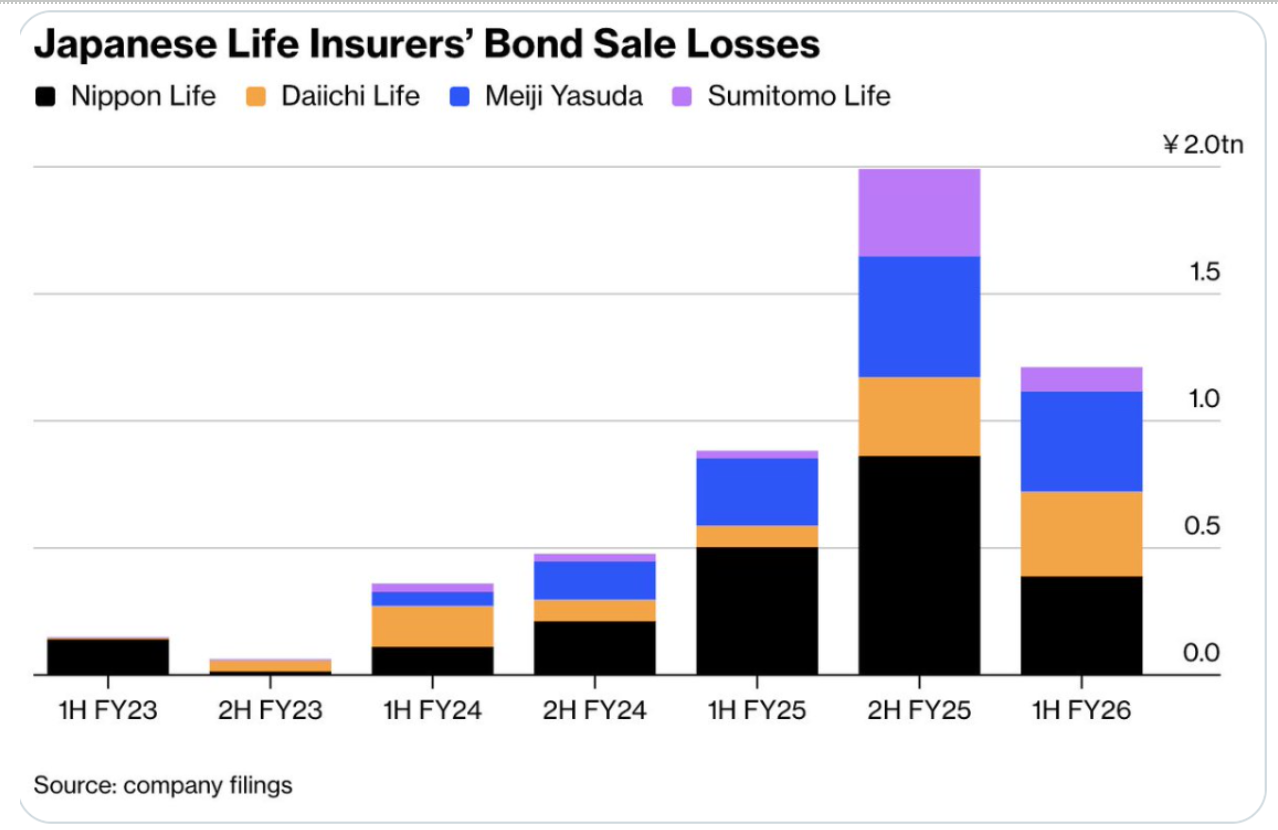
Japan’s four largest life insurers realized about ¥1.2 trillion, or roughly $7.5 billion, in bond sale losses in just six months.
These companies are selling bonds they bought when yields were near zero and moving the money into new bonds that pay much more.
They’re accepting a hit now in exchange for higher interest income for years to come.
Massive Losses for All
The chart above covers recent filings from Nippon Life, Daiichi Life, Meiji Yasuda and Sumitomo Life.
Losses were small in the first half of fiscal 2023, then climbed through each period.
They peaked near ¥2.0 trillion in the second half of fiscal 2025, and the latest period, the first half of fiscal 2026, comes in at about ¥1.2 trillion.
Nippon Life has the biggest piece in most periods, and the other three account for large shares in the recent ones.
Why sell at a loss?
Those older bonds pay very little.
If an insurer holds them to maturity, it avoids the loss but keeps earning a low yield for a long time.
Selling, taking the loss and buying bonds at today’s higher yields can pay off over time.
The catch is that the loss is real and immediate, while the extra income arrives slowly.
It also shows that government bonds aren’t risk-free in price terms.
Hold to maturity and you get your money back.
Sell early after rates have gone up, and you can lock in a large loss.
What fixed income investors can learn from it
Bond prices fall when yields rise, even for government bonds. The longer the maturity, the bigger the move.
A loss isn’t “realized” until you sell. Holding to maturity is one way to avoid it.
Selling low-yield bonds to buy higher-yield ones can raise your income, but check how long it takes to earn back the loss.
Big institutions face the same choice individuals do: stay with a low coupon or take the loss and reinvest.
If you own bonds bought when rates were lower, compare your yield with what new bonds pay before you decide.
Bottom line
The insurers aren’t panicking. They’re taking losses on purpose so they can earn more later. The lesson for everyday investors is the same: a government bond is safe if you hold it to maturity, but it can lose real value if you have to sell early. Know your time horizon before you buy.