
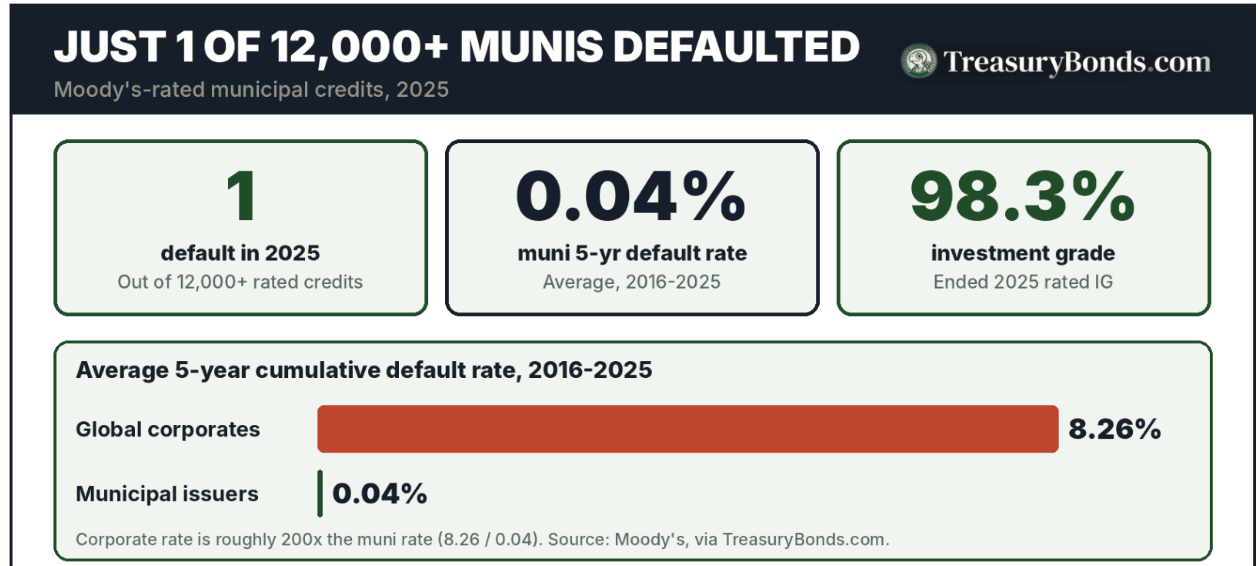
Out of more than 12,000 municipal credits rated by Moody’s, exactly one defaulted in 2025.
For investors who want tax-exempt income, it’s a big reason municipal bonds have such a loyal following.
The numbers behind the headline
Moody’s data shows the average 5-year cumulative default rate for municipal issuers from 2016 through 2025 was just 0.04%.
For global corporate issuers over the same stretch, it was 8.26%.
Put another way, the corporate rate is roughly 200 times higher (8.26 ÷ 0.04).
On top of that, 98.3% of Moody’s-rated municipal credits ended 2025 with investment-grade ratings.
What the numbers don’t tell you
Low default risk is not the same as no risk.
Muni investors still face interest-rate risk, because bond prices fall when yields rise.
Many munis can also be called, which means the issuer can pay you back early, often when rates have dropped and you’d rather keep the bond.
And the comparison with corporates isn’t perfectly apples to apples.
Munis and corporates are different kinds of borrowers with different structures, and a default statistic covers only rated credits, not every bond in the market.
A bond can lose value or be called without ever defaulting.
What it means for fixed income investors
Default risk for rated munis has been very low, but price risk and call risk are still real.
Check the bond’s call date and yield to worst, not just the coupon.
Compare muni yields on a tax-equivalent basis against taxable bonds for your bracket.
Diversify across issuers and sectors.
Bottom line
For tax-exempt income, munis have earned their reputation. Look at maturity, call features and taxes before you buy.