
Chicago Fed president Austan Goolsbee didn’t mince words on September’s inflation report. He called it “discouraging,” and said last month’s was too.
- Headline CPI came in at 3.7%, a touch above the 3.6% economists expected and up from 3.4% in August. Core CPI, which strips out food and energy, rose 0.3% for the month, versus the 0.2% expected, and the year-over-year rate ticked up to 2.6% from 2.4%.
- The number Goolsbee is focused on is the one you get if you take September’s core pace and run it for a full year. That works out to about 4%, and he said flatly that “that’s not acceptable” and not compatible with the Fed’s target.
- But he isn’t ready to hike yet. He wants to see more data and figure out the “through line” first. What bothers him is that this can’t all be blamed on tariffs or oil. Services inflation is running above 5% with little sign of cooling, and core goods inflation is still above 3% when it should have faded as tariffs worked through. That points to inflation that sticks around.
- He also said the AI data center build-out needs close watching because it could overheat the economy. For bond investors, the message is that the Fed isn’t cutting anytime soon, and a hike is still on the table if the next reports look like this one.
On another late-day note, The New York Fed reported it's only buying about $14.6 billion in Treasury bills between October 15 and November 13, and that money comes entirely from bills it already owns that are maturing. It’s swapping old bills for new ones, which keeps its holdings flat. The Fed is deciding not to add more cash to the banking system for now.
Why it should matter for fixed income investors
It’s a sign the Fed isn’t easing. More bill buying would pump cash into the system, push short-term rates down a bit, and give bonds a tailwind. Holding off fits with what Goolsbee said about inflation.
It’s not tightening, either. Reinvesting maturing bills keeps the balance sheet steady. This is a pause on adding money, so it isn’t a reason to panic.
Short-term rates could feel it first. When the Fed adds less cash, banks have less spare cash to lend. That can nudge money market and repo rates up around the edges, especially at month-end or around big Treasury settlement dates. It matters most for T-bills, money market funds and short-term bond funds.
The amount is small. $14.6 billion is a drop in a Treasury bill market that’s several trillion dollars. This is a signal more than a force.
Mid-November is the date to watch. The post says markets expect new purchases to resume then. If they do, that’s a mild positive for short-term bond prices. If they don’t, it’s another sign the Fed is staying firm.
It supports the case against stretching for yield. With inflation running hot and the Fed not adding liquidity, I’d keep favoring short and middle maturities and high credit quality over chasing the long end.
Bottom line
This is a quiet signal that the Fed sees no reason to help markets right now. Markets are stable, inflation is sticky, and the Fed isn’t going to rescue anyone. For bond investors, it means don’t count on a Fed tailwind, and keep earning the yield in short and middle maturities.
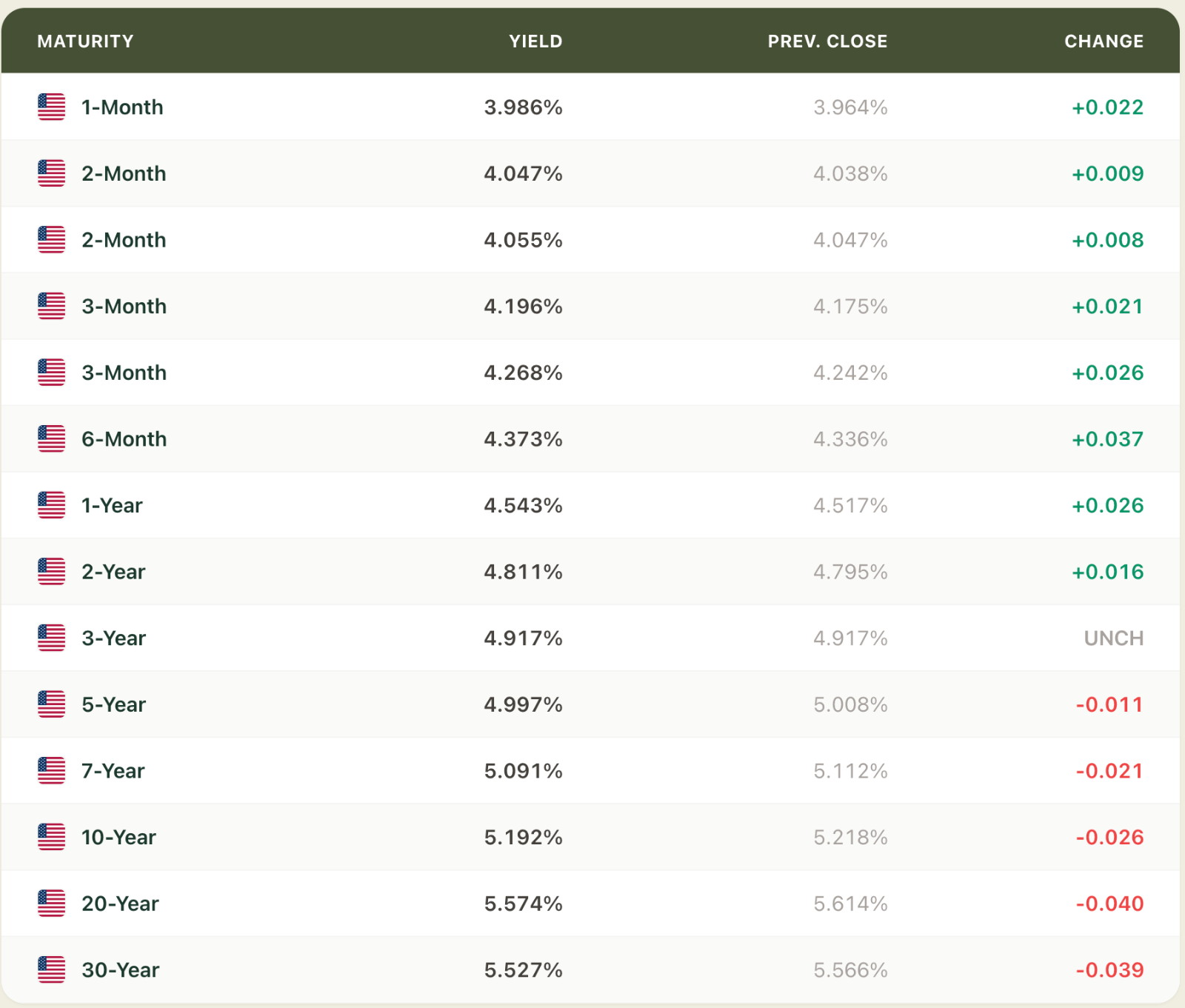
Where Treasury Rates are ending the day:
Inflation is a global story right now, and central banks are splitting on how to respond:
- The Monetary Authority of Singapore left its policy stance unchanged, even though the market expected tightening.
- The European Central Bank sounds more hawkish. Lagarde repeated that it isn’t seeing second-round effects (where higher prices feed into wages and then more prices), but policymaker Wunsch said the ECB will probably have to hike again.
- Germany’s Economics Ministry said the economy likely lost momentum in Q3, and German wholesale prices rose 1.9% in September alone, up 8.7% from a year ago, versus 6.8% the month before.
- Spain’s inflation came in at 4.9%, up from 4.3%, and its core rate rose to 3.1%. India is seeing the same pressure, with wholesale inflation at 11.39% and fuel inflation at 25.85%.
China is a more mixed picture.
- Consumer prices were soft, up just 0.9% from a year ago and slightly below expectations, but producer prices jumped 5.0%, well above the 4.4% expected.
- Exports were up 36.3% and imports 31.0%, both well above forecasts, and the September trade surplus was $133.5 billion. New loans and total social financing also came in above expectations, though M2 growth slowed to 7.2%.
- South Korea may cut its debt issuance by up to KRW 10 trillion, which would mean fewer bonds hitting the market.
With stocks selling pretty heavily into the close, a flight to safety trade could be developing for treasuries. Have a great night everybody. Back at it tomorrow!