
The weakest borrowers face costs of about 17%, the highest since May 2020. The extra yield they pay over Treasuries for CCC-or-lower credits is around 12 percentage points, the widest since 2022. That lines up with the CCC spread chart we looked at earlier this week.
Some deals are being pulled or delayed as investors get pickier.
- Bank of America cut its forecast for October investment-grade dollar issuance to $110 billion from about $160 billion.
- A record $1.45 trillion of investment-grade debt comes due between 2026 and 2030, per Moody's.
- Futures traders expect three or four more Fed hikes by early 2028, from the current 3.75% to 4% range.
The CFO's checklist
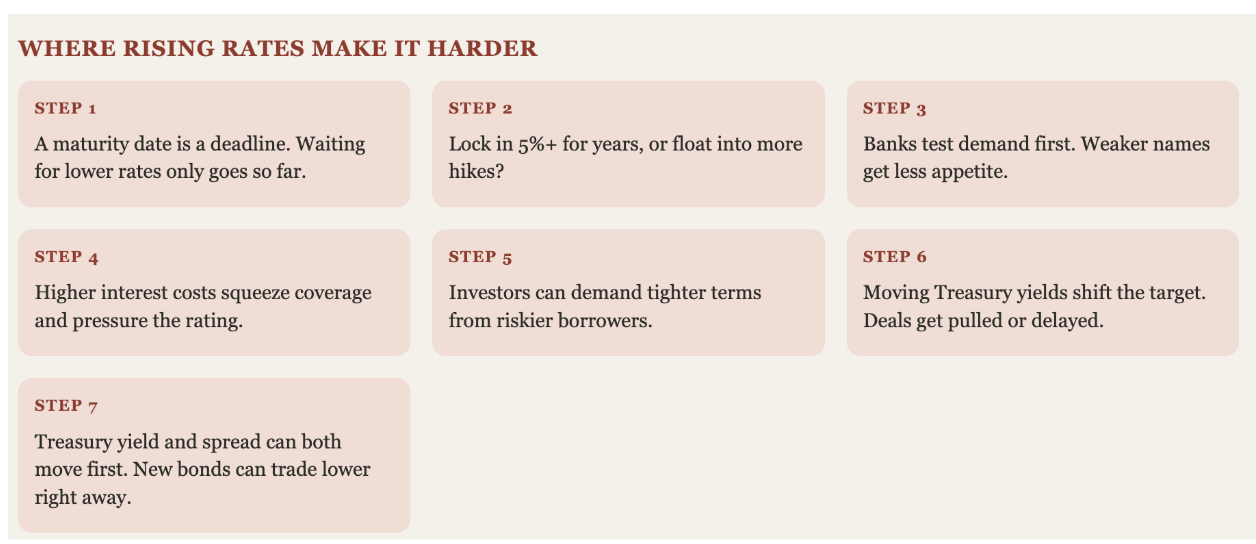
Issuing bonds is a process, and each step has a place where rising rates make life harder. I built a visual walking through all seven steps, from deciding you need the money to getting cash in the bank.
The price follows a simple formula: the coupon is roughly the Treasury yield plus a credit spread. The Treasury piece is what the whole market pays. The spread is what your company pays for being your company. For the weakest borrowers today, that's about 5.3% plus about 12 points, which gets you to roughly 17%.
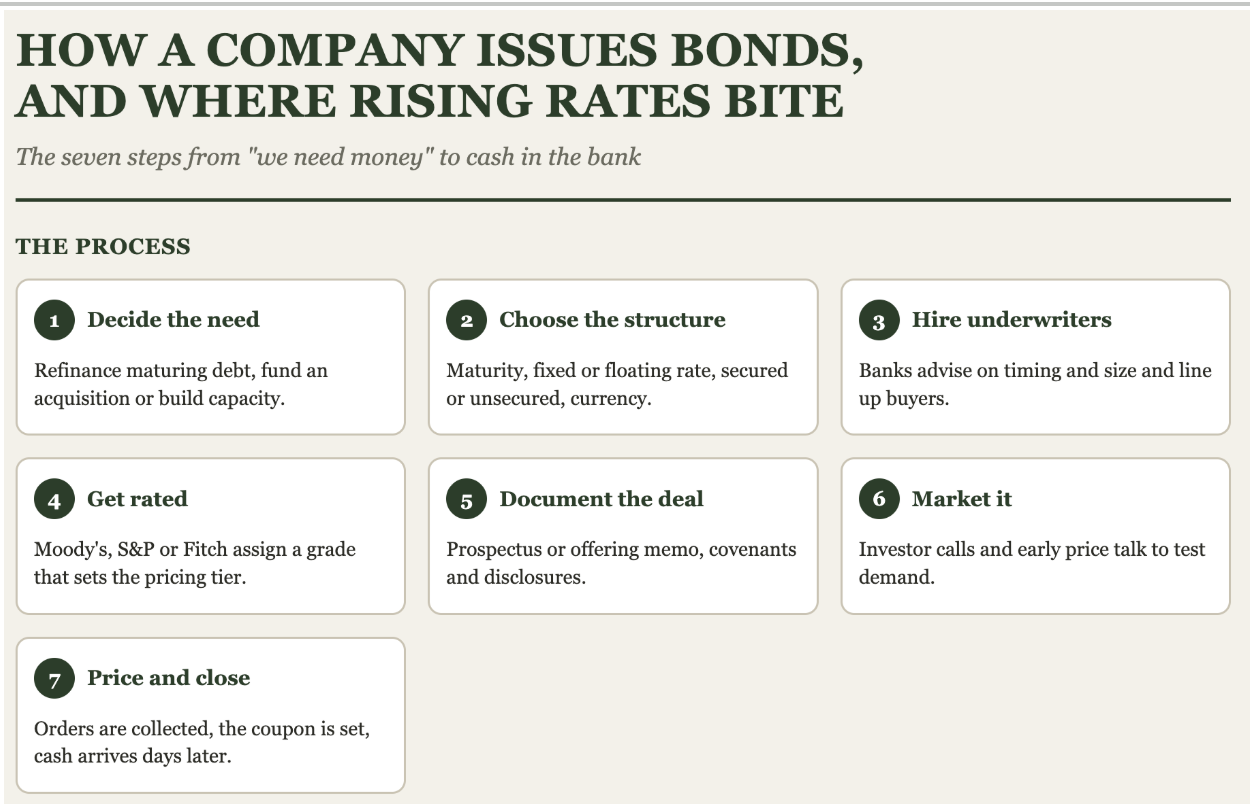
Why a rising-rate environment is tricky
1. The target keeps moving. A CFO can decide on a deal Monday and have the market move before pricing day. When Treasury yields jump, the cost of the whole deal moves with them. That's why deals get pulled. The company needs the money, but the numbers make the deal less attractive.
2. Fixed or floating is a real bet. Lock in a fixed rate above 5% for ten years and you may regret it if yields fall. Borrow floating and you're exposed if those three or four hikes futures traders expect show up. McCormick, which is weighing currency mix, duration and fixed-versus-floating rates for debt tied to its Unilever foods merger, is a good example of how many dials a treasurer has to turn at once.
3. Investors are telling issuers what they want. When Paramount Skydance sold $52 billion of debt to help fund its $110 billion Warner Bros. Discovery acquisition, demand for its two-year bonds was nearly double that for its 30-year bonds, and the bonds sold off once trading began. That's the market saying: we'll lend short, but we don't want your long duration at these prices.
4. The maturity wall gets expensive. Say a company has $1 billion of debt it issued at 2.5% back in 2020. That costs $25 million a year. Refinance it at 5.5% and it costs $55 million. That's $30 million more every year, with no change in the business. Multiply it across $1.45 trillion of debt coming due and you can see why this is a multi-year theme.
5. Waiting isn't free. If the bond matures in six months, "wait for lower rates" isn't an option. That's the forced-seller problem, but on the borrower's side. Companies without a deadline can wait. Companies with one pay whatever the market asks.
6. Higher interest costs hurt the rating. More of a company's earnings goes to interest, coverage ratios shrink, and rating agencies notice. A lower rating raises the spread on the next deal. It's a loop, and it's most dangerous at the bottom of the credit ladder, where the FT says default risk is rising.
The two-tier market again
The strongest companies can still borrow, and AI-related stocks are booming. The weakest ones are staring at 17%. The investment-grade issuer might pay a bit more and shrug. The CCC issuer is deciding whether it can afford to borrow at all. The wide spread between them is the market sorting borrowers into those who can handle higher rates and those who can't.
The playbook for fixed income investors
New issues can pay you. When borrowers have to pay up to get deals done, buyers often get a concession. A thinner calendar and nervous issuers shift leverage toward investors.
- Watch issuance, not just spreads. Cut forecasts and pulled deals are an early read on how stressed borrowers are.
- Quality over reach. A 17% yield looks tempting until you remember it exists because the market thinks default risk is real. If you want corporate exposure, the investment-grade names with long runways are on the right side of this divide.
- Think about floating-rate paper. If more companies choose floating-rate debt, there may be more of it to buy. It protects against rising rates but not against a borrower that can't pay.
- Treat the maturity wall as a theme. Companies refinancing low-coupon debt at much higher rates will see earnings pressure for years. Look at who has big maturities coming and weak coverage.
- Asset location still matters. If you do buy corporate bonds, they belong in the IRA or 401k before the taxable account, since the interest is taxed at ordinary rates.
The bottom line
For the last decade, companies could borrow at almost any rate they wanted, and the only question was how much. Now the questions are when, how long, fixed or floating, and whether the market will take the deal at all. Rising rates make every decision in the process harder, and the weakest borrowers have the fewest options. If you own corporate bonds, the thing to ask isn't what the yield is, but whether the company can refinance when its bonds come due.